Agent Self-Reminders
Let a running agent schedule a one-shot future re-invocation of itselfwith a message it writes — “check this PR in 2 hours”, “review the deploy tomorrow at 9am”. When the timer fires, Trinity dispatches a normal execution of that same agent carrying the reminder message. Nothing is held open in between; the reminder is a durable row that fires once, later.
Reminders are the time-deferred sibling of Agent Loops. A loop runs iterations back-to-back now; a reminder fires once, at a chosen time. Both are durable: a reminder is persisted and re-armed automatically, so it still fires after a backend or scheduler restart.
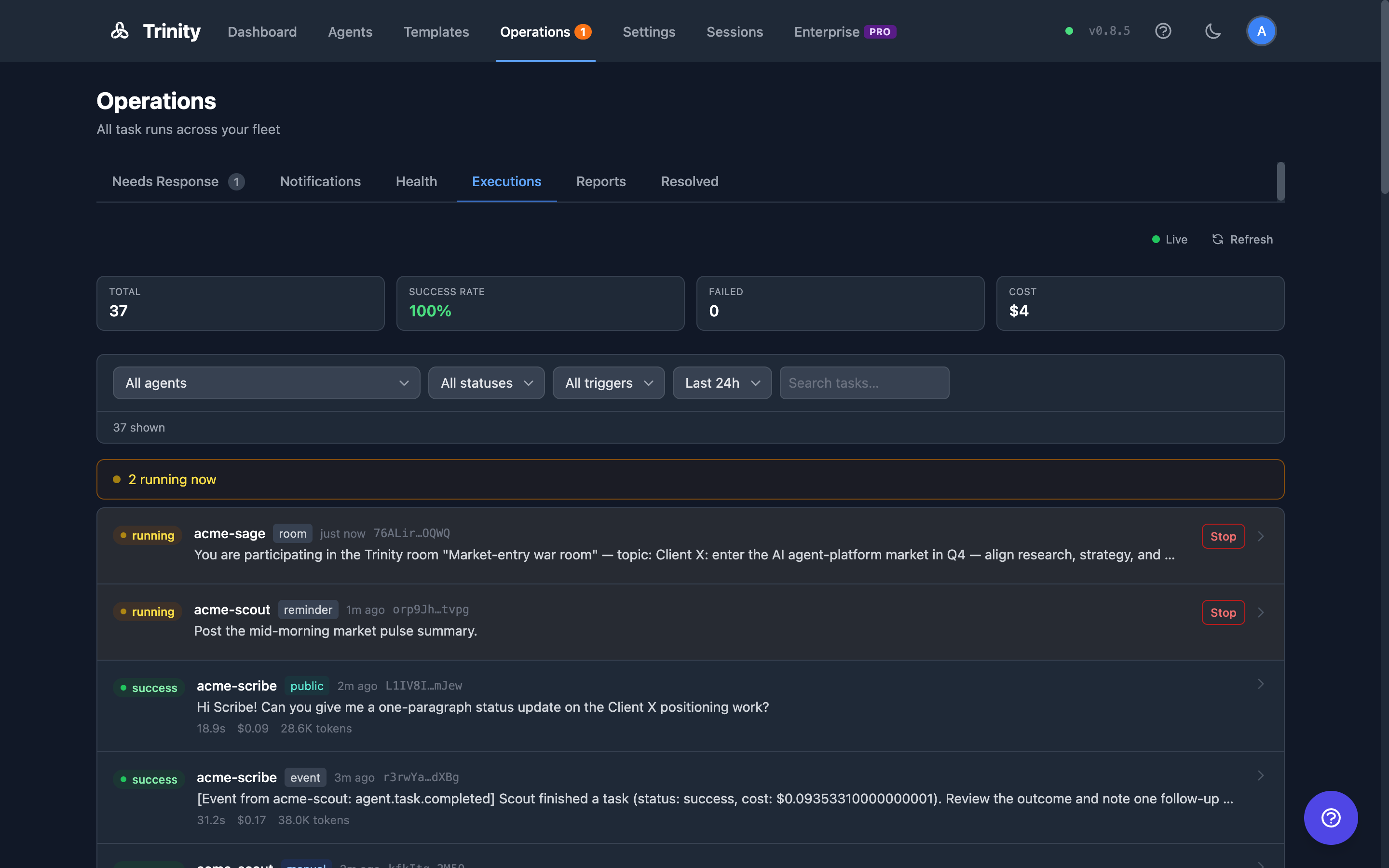
There is no web UI for reminders. They are a backend and MCP primitive that agents drive themselves. Fired reminders show up in the standard Executions list and the agent's Overview timeline under a distinct Reminders category.
Concepts
403).Reminder vs. Loop vs. Schedule
Pick by when and how often the work should run:
| Tool | Cardinality | Timing | Durable across restart |
|---|---|---|---|
| Reminder | Once | A future instant you choose | Yes |
| Loop | Up to max_runs times | Back-to-back, starting now | Yes |
| Schedule | Recurring | A cron cadence | Yes |
Reminders are the agent-initiated, one-shot, durable counterpart to cron schedules — use a reminder for a single deferred follow-up, a schedule for a recurring cadence.
How It Works
An agent sets a reminder one of two ways — pick exactly one:
delay_seconds — fire this many seconds from now (e.g. 7200 for two hours). Best for relative follow-ups.fire_at — an absolute ISO 8601 timestamp (e.g. 2026-07-25T09:00:00Z). Best for “tomorrow at 9am”.Optional per-reminder overrides — model, timeout_seconds, and allowed_tools— apply to the execution that fires, exactly as they would for a one-off task. When the reminder fires, the resulting execution shares the agent's normal capacity budget alongside chat, schedules, and loops.
Listing returns pending reminders by default (soonest fire first); pass a status filter of all to see fired, cancelled, and failed reminders too.
Cancelling a still-pending reminder stops it from firing. Cancelling an already-cancelled reminder is a no-op success; a reminder that has already fired, is mid-fire, or has failed cannot be cancelled (409). An unknown reminder id returns 404.
Autonomy must be on
A reminder set on an agent whose autonomy mode is off is accepted and held: it stays pending, is never armed, and does not fire — even once its fire time passes. Turn autonomy on and it fires past-due within about a minute. Nothing is lost, but nothing happens either.
Because autonomy defaults to off on a new agent, this is the usual reason a first reminder “never fires”.
How to tell:
list_reminders set autonomy_hold: true on any reminder in this state, and the set_reminder tool result adds an explicit warning. An agent should relay that to the user rather than reporting the reminder as scheduled.2 reminder(s) held: their agent's autonomy is disabled.Chat is notautonomy-gated, so an agent can be mid-conversation, accept “remind me in an hour”, and still be unable to fire it. Check autonomy when a user asks for a reminder.
Where fired reminders appear — a fired reminder is a normal execution row (with triggered_by: "reminder"), so it appears on the Executions page, in per-execution detail, and as its own Reminderscategory in the agent's analytics timeline — never folded into Scheduled.
For Agents
Agents drive reminders via MCP tools or REST. The self-only rule holds on both surfaces: an agent-scoped key may act only on the agent it is bound to.
MCP Tools
| Tool | Description |
|---|---|
| set_reminder | Schedule a one-shot self-reminder. Args: message, plus fire_at (ISO timestamp) or delay_seconds — exactly one. Optional: model, timeout_seconds, allowed_tools |
| list_reminders | List the agent's reminders (pending by default; status: "all" for every state), soonest fire first |
| cancel_reminder | Cancel a pending reminder by id |
mcp__trinity__set_reminder({
  agent_name: "my-agent",
  message: "Re-check the open PR — is CI green yet? If so, merge it.",
  delay_seconds: 7200
})
// → { success: true, reminder: { id: "rem_...", status: "pending", fire_at: "..." } }
REST API
| Endpoint | Method | Description |
|---|---|---|
| /api/agents/{name}/reminders | POST | Create a one-shot reminder; returns 201 with the reminder |
| /api/agents/{name}/reminders | GET | List reminders (?status=pending default, ?status=all for every state) |
| /api/agents/{name}/reminders/{id}/cancel | POST | Cancel a pending reminder |
curl -X POST http://localhost:8000/api/agents/my-agent/reminders \
  -H "Authorization: Bearer $TOKEN" \
  -H "Content-Type: application/json" \
  -d '{
    "message": "Review the deploy health dashboard and report anomalies.",
    "fire_at": "2026-07-25T09:00:00Z"
  }'
Both create boundaries accept an optional Idempotency-Key header, so a naive retry does not schedule a duplicate reminder.
See the Backend API Docs (/docs on your instance) for full request and response schemas.
Limitations
403.set_reminder returns 429.timeout_secondscannot exceed the agent's execution timeout cap.