What's New in Trinity v0.9.0
Watch the release tour — a walkthrough of everything below.
Trinity's biggest release yet is about opening the platform outward. Workspace — the client-facing surface — moves into every build, with multi-agent conversations, an agent page per agent, and streaming replies. A fresh install now provisions itself: agent templates arrive from a remote registry, whole multi-agent systems install from a manifest in the UI, and a guided checklist walks each agent's credentials. The skills library becomes multi-source, A2A becomes bidirectional, the dashboard learns to draw your org chart, Agent Reports are complete, and the platform starts backing up its own database nightly — alongside one of the deepest security hardening passes Trinity has shipped.
Beneath the individual features runs one theme: structure. This release introduces a new level of organization into agentic systems — the primitives agents need to collaborate: departments and reporting lines on the platform side; canon, orchestration, playbooks, project management, and guided creation on the marketplace side — and a much tighter integration between the two, with the multi-source skills library serving marketplace skills straight into your fleet.
Improvements
The fleet is the org chart
The Grid view gains an org overlay: departments render as labelled zones around their member tiles and reporting lines as arrows between them — drag a tile into a zone to reassign it, all stored as ordinary agent tags. A new widget chassis puts fleet-level data tiles on the same canvas (Executions by trigger, Recent failures), the standalone Agents page folded into a dashboard List view, and / type-to-filter works across all three views.
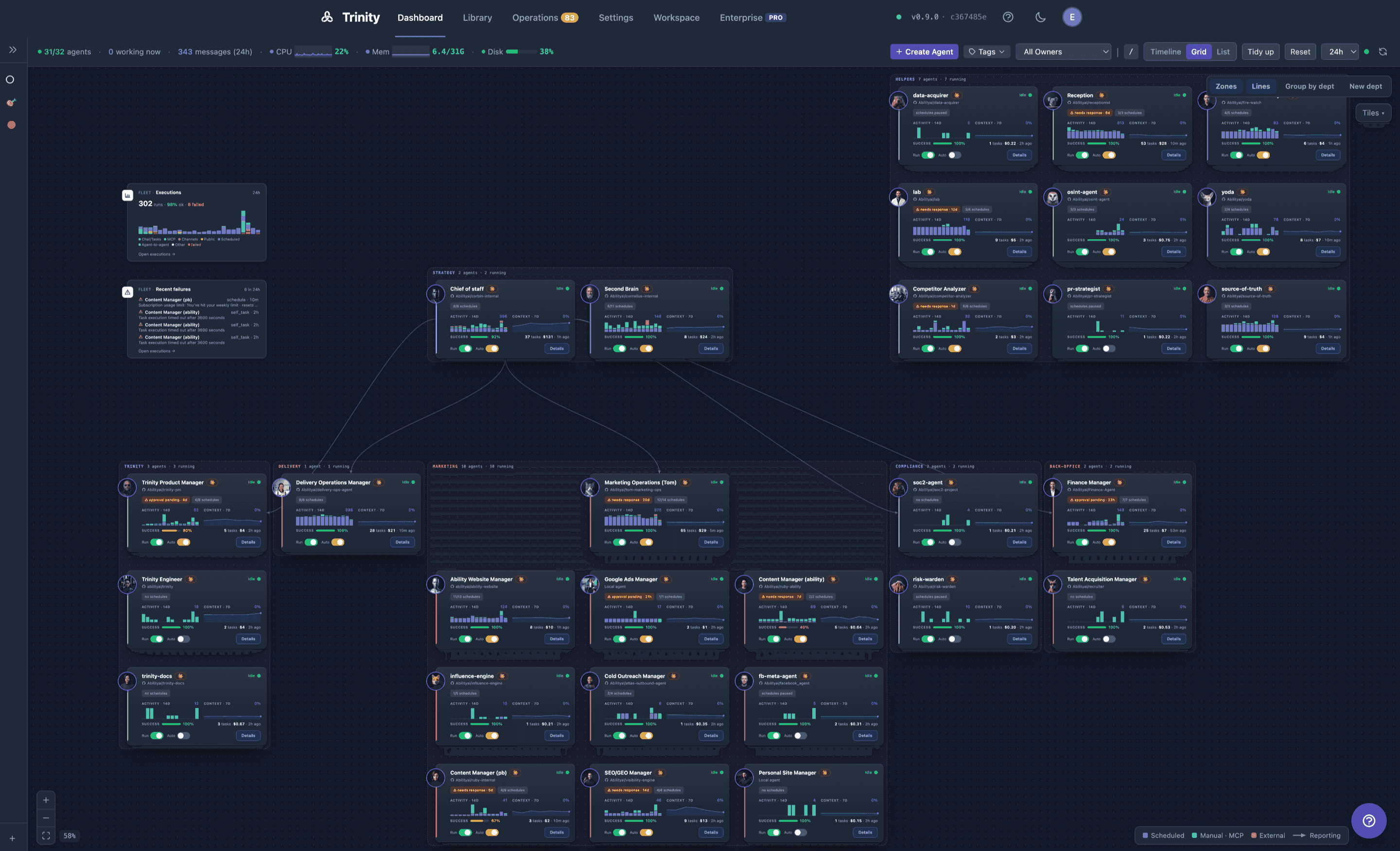
See Dashboard.
Inside one agent
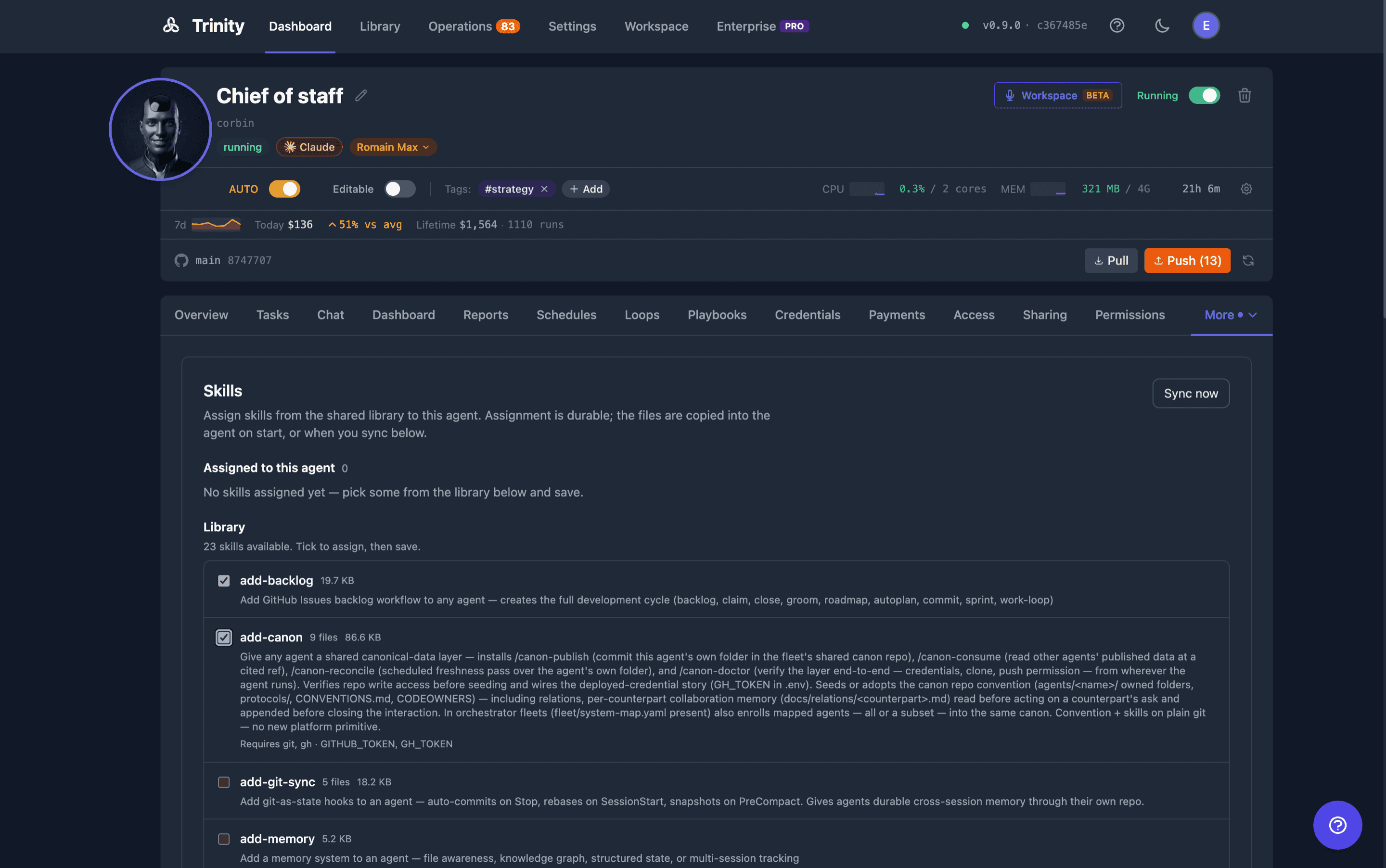
Agent Detail stays the operator's view of the whole agent — repo + CLAUDE.md + skills + cron + credentials + volume — and this release rebuilds two of its panels. The Skills tab is new from the ground up: browse the library, assign, and read an honest per-skill injection status. And agent MCP keys become first-class — visible, verifiable, regenerable, and self-healing — instead of something you discover when it breaks.
Workspace — the client surface, now in every build
The client portal moved from an enterprise module into OSS core and became Workspace: one click from the platform, a sidebar with your agents, starred and dated chats, and an agent page per agent — what it's been doing, its reports and files, and what it needs from you. Chats stream as they happen, sessions renew instead of expiring mid-conversation, and the composer understands / for playbooks and @ for agents. Start a chat with one or several agents, or @mentionanother agent mid-chat to bring it in. Clients sign in with an emailed one-time code, sign-out really signs out, and per-client rate limits keep the surface safe to share. The old Sessions page is retired — Workspace absorbed it.
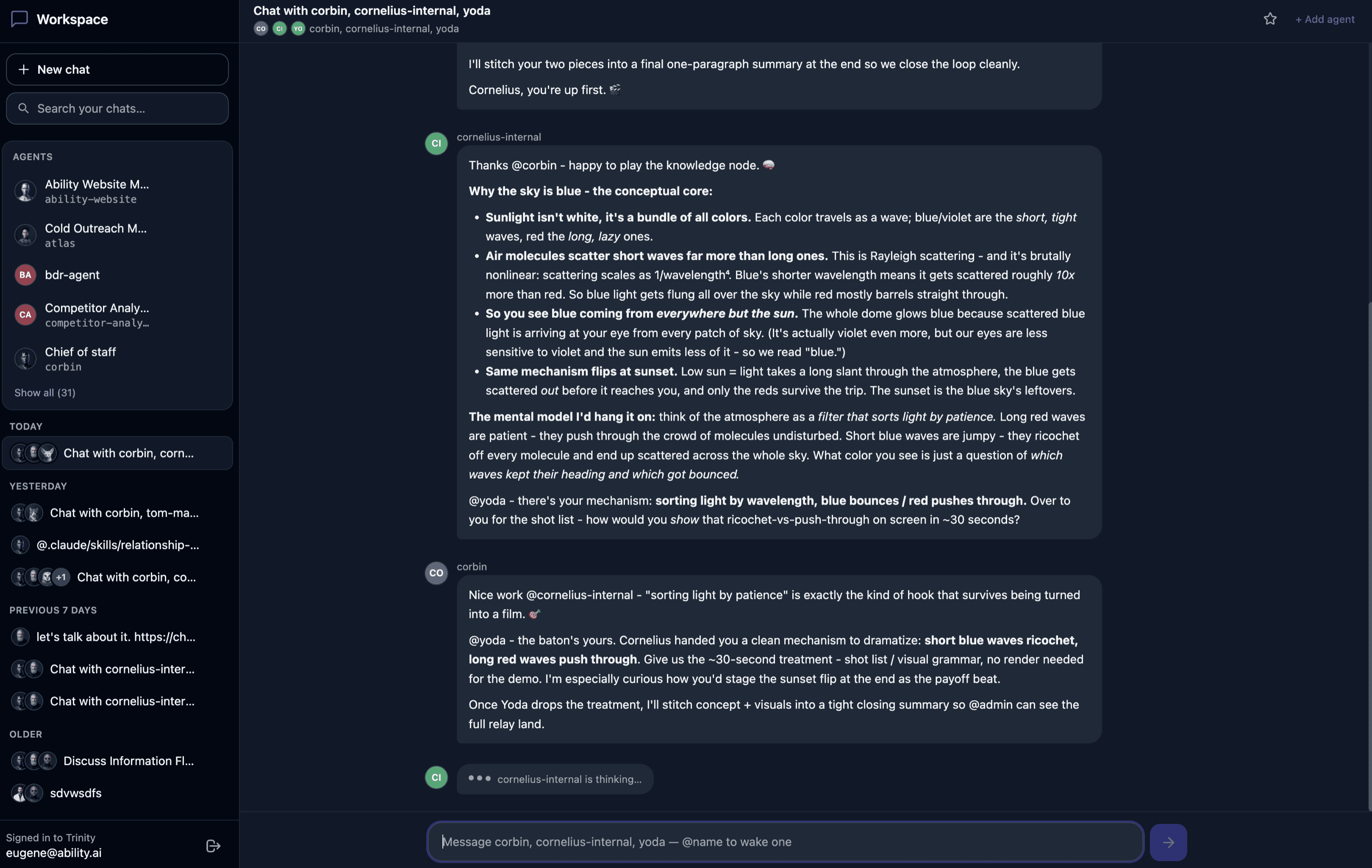
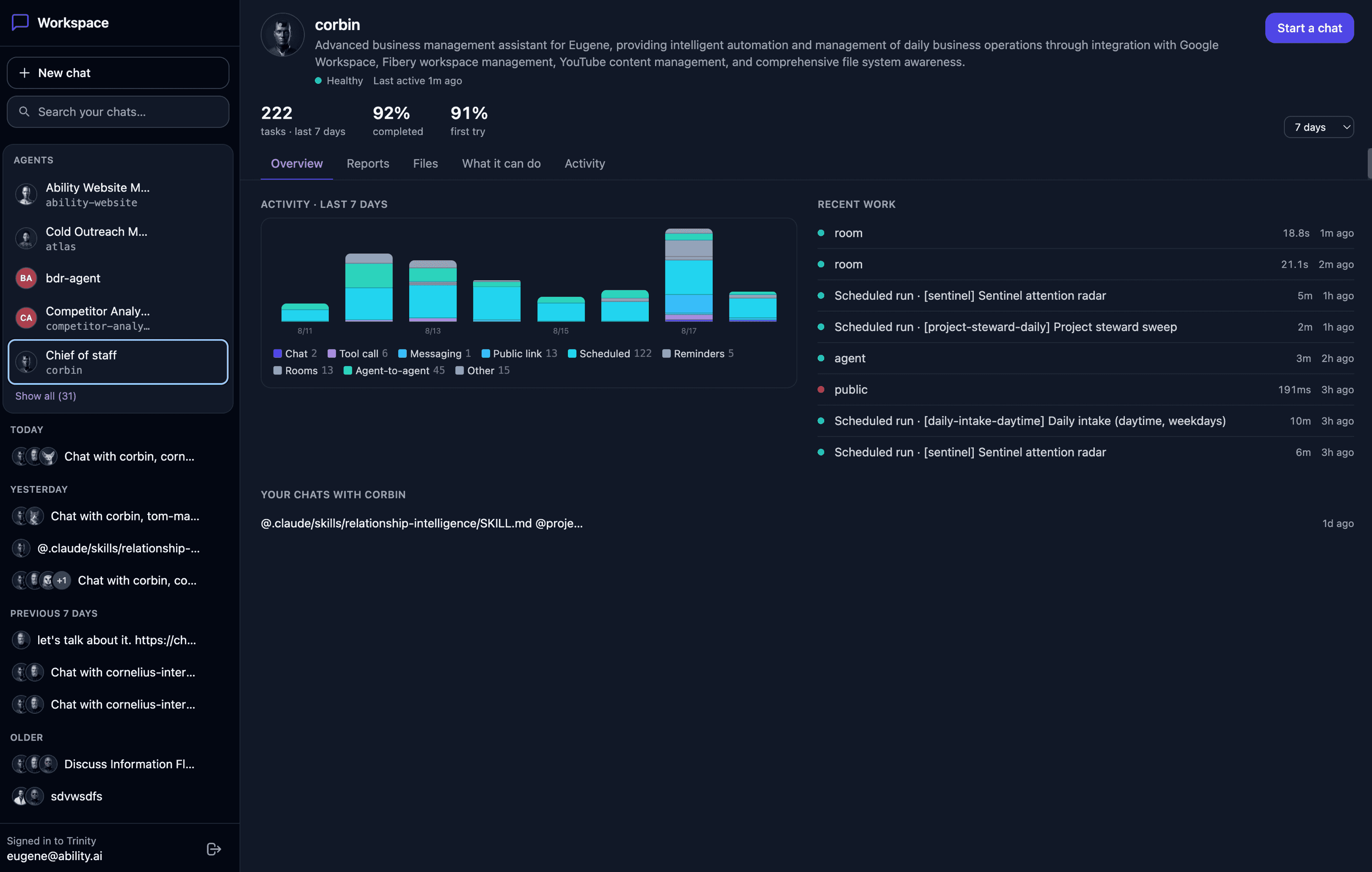
See Workspace.
Provisioning from zero
The agent catalog now resolves through a remote template registry that updates without upgrading Trinity (live status in Settings). A GitHub-repo import wizard turns any repository into an agent — fork it, copy it, or clone your own, and a public repo needs no PAT at all — with an inline compatibility check. Whole multi-agent systems install from a manifest in the UI (pick a bundled one, upload, or paste YAML — dry-run previewed before anything runs), guided per-agent credential setup shows a required-credentials checklist with how-to-get instructions, schedules declared in template.yaml are materialized at creation, and you can bind an existing agent to a repo you own after the fact from its Git tab.
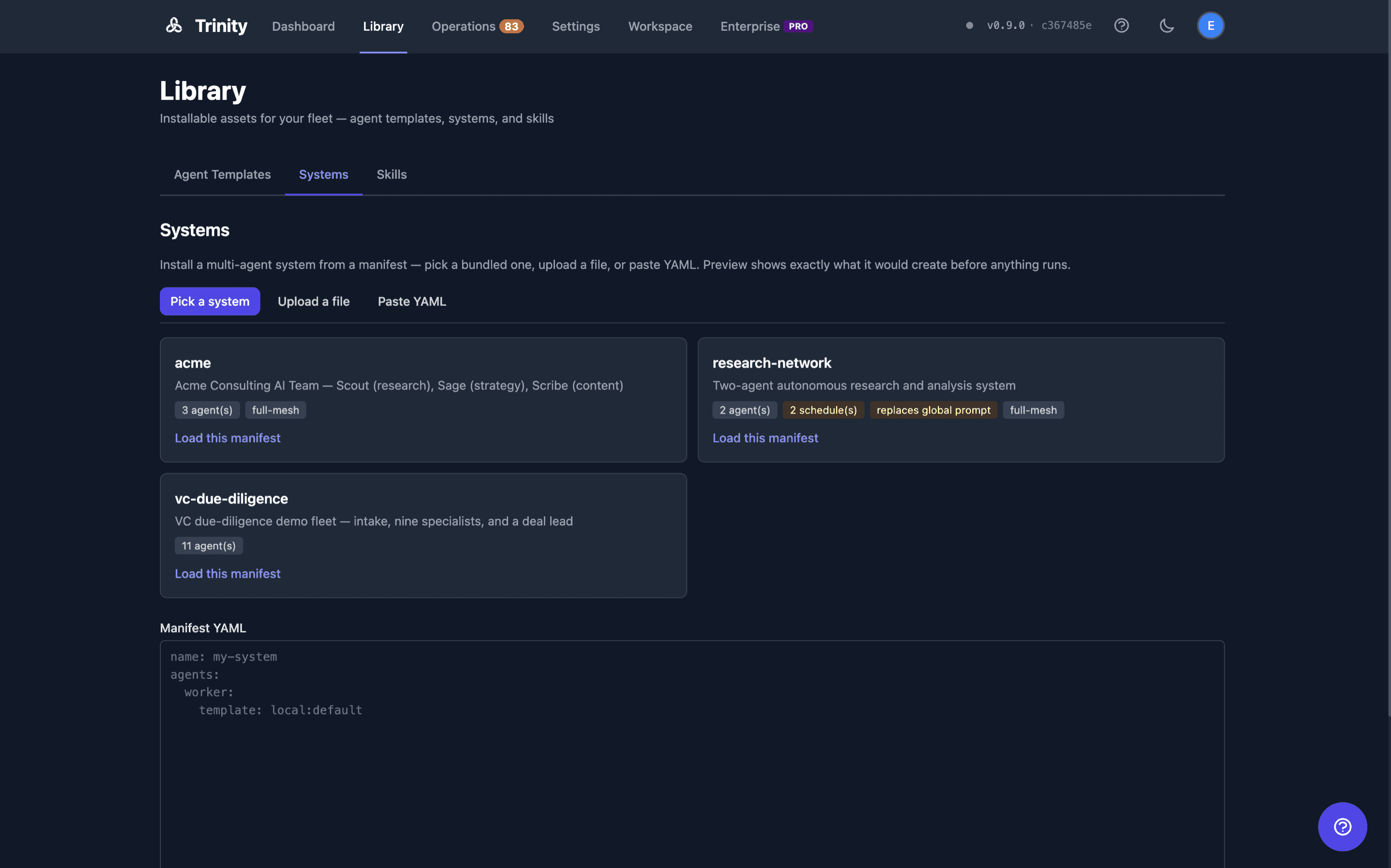
See Creating Agents and System Manifest.
A multi-source skills library, managed for the whole fleet
The Templates page is now Library — one surface for agent templates, systems, and a tabbed Skills section that shows which agents hold each skill. The library itself syncs from multiple sources — a bundled, tag-pinned community catalog plus your own repositories (your repo always wins a name clash) — and its lifecycle is automated: scheduled auto-sync, fleet-wide re-inject, and removal-on-unassign. Distribute, place, expose — one model.
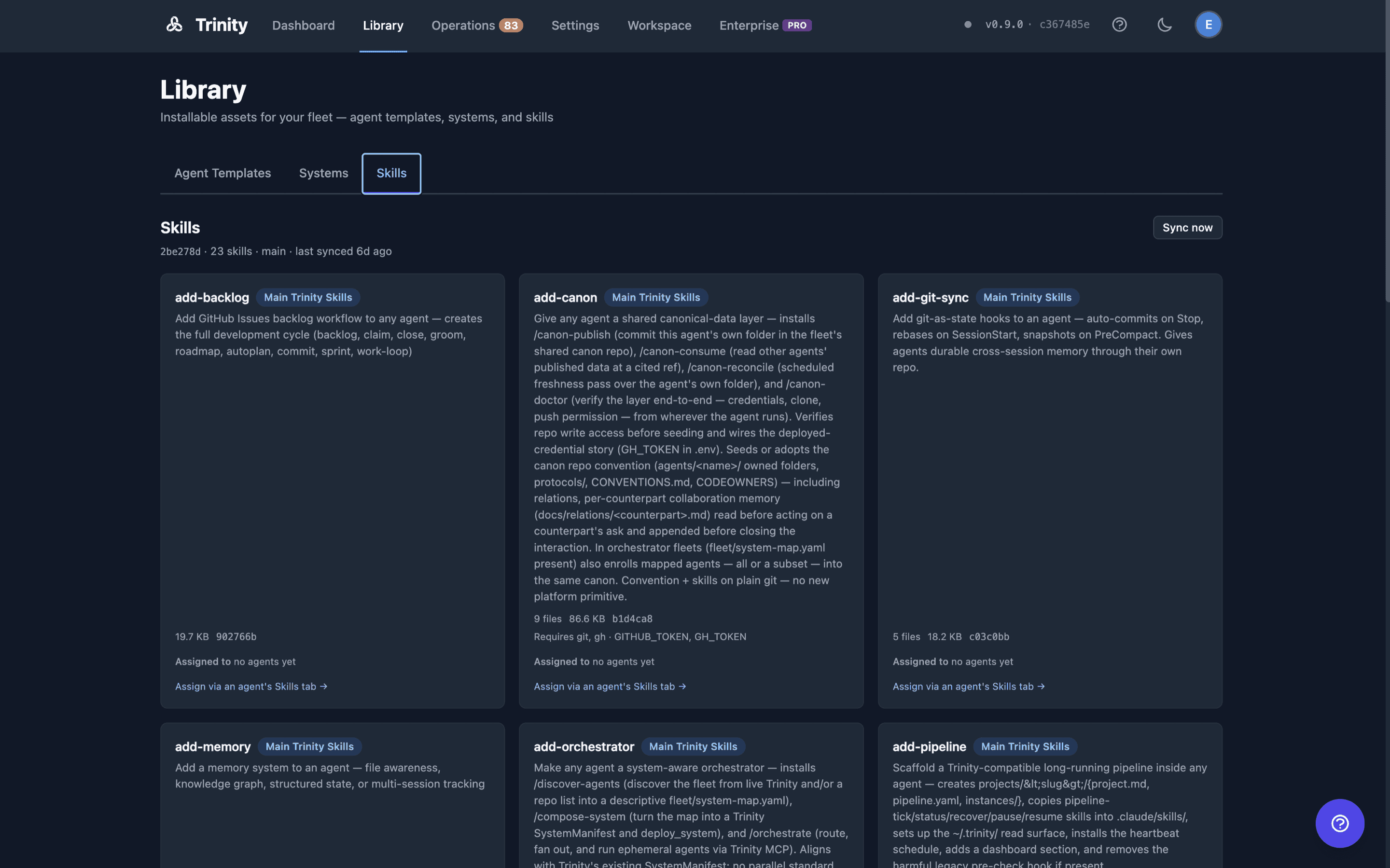
See Skills and Playbooks.
The plugin marketplace: primitives for organized fleets
The platform work has a mirror in the Cloud Code Plugins marketplace, which now covers the whole arc of an agentic system — create it, extend it, organize it, and let its agents collaborate:
/trinity:start-here is a guided, resumable journey from “what is Trinity?” to your first agent alive on your own instance. Answers come from live documentation, not a script — through the public docs Q&A endpoint before you have an instance, and through your instance's own ask_trinity tool after./agent-dev:agent-fleet-analysis scans directories of agents in anyparadigm — Claude Code, n8n exports, LangChain/CrewAI/AutoGen apps, freeform-coded loops — scores their maturity, maps every gap to an installable marketplace skill, and emits a report plus a work order that /agent-dev:agent-fleet-migrate executes as a non-destructive, verified migration.add-canongives a fleet a shared canonical-data layer — each agent publishes the facts others may rely on, with publish/consume/reconcile/doctor skills — and add-canon-lint makes it deterministic: a two-zone schema, linted in CI on every push.add-orchestratormakes any agent system-aware: discover the fleet, compose systems aligned with Trinity's SystemManifest, and route and fan out work.add-project-managementinstalls cross-actor project management — GitHub Issues as the single source of truth and an approval-ready completion lattice.create-agent wizards scaffold new Trinity-compatible agents, and /agent-dev:create-playbook turns a working procedure into a reusable skill.And the loop closes inside the platform: the multi-source skills library above serves these same marketplace skills to your fleet — browse them in Library → Skills, assign them from an agent's Skills tab, and let library automation keep them synced.
See Cloud Code Plugins.
One task, end to end
The structural pieces above compose into one flow. A client asks in Workspace, the PM delegates with a playbook call, the engineer pulls a skill from the library and a fact from the canon — permissioned, audited, and reported back to the human. Forty-two seconds, no narration needed.
Agent Reports, complete
The reports epic closes: agents get prompt guidance on when and how to publish, Excel and PDF export, large payloads page instead of choking the browser (5 MiB cap, row-windowed table reads), agents read back their own reports over MCP, and both the fleet and per-agent views gain search and filters.
See Agent Reports.
Agents talking outward — A2A in both directions
Trinity agents can now be tasked from outside over the open A2A protocol: per-agent opt-in exposure publishes a public Agent Card and a JSON-RPC/SSE task endpoint, configured from a dedicated panel — card URL, advertised skills, inbound allow-list — or over MCP. And they can call outward: the new call_a2a_agent tool tasks external A2A agents from an operator-registered endpoint list. On the channel side, Telegram gets an in-progress indicator while a task runs, and a long task reports back to the chat it came from when it finishes.
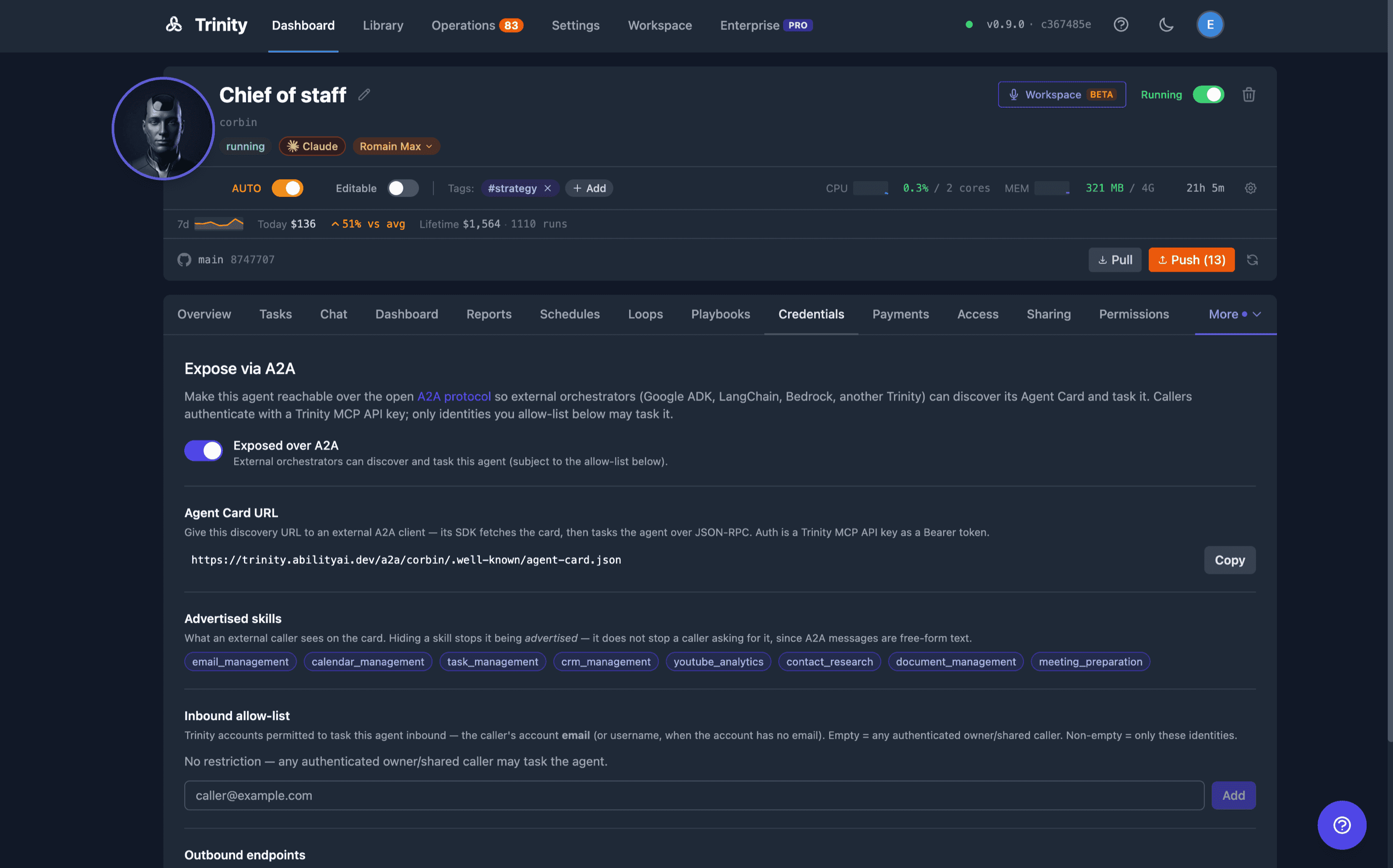
See A2A Agent Card.
Ops: the platform keeps itself recoverable
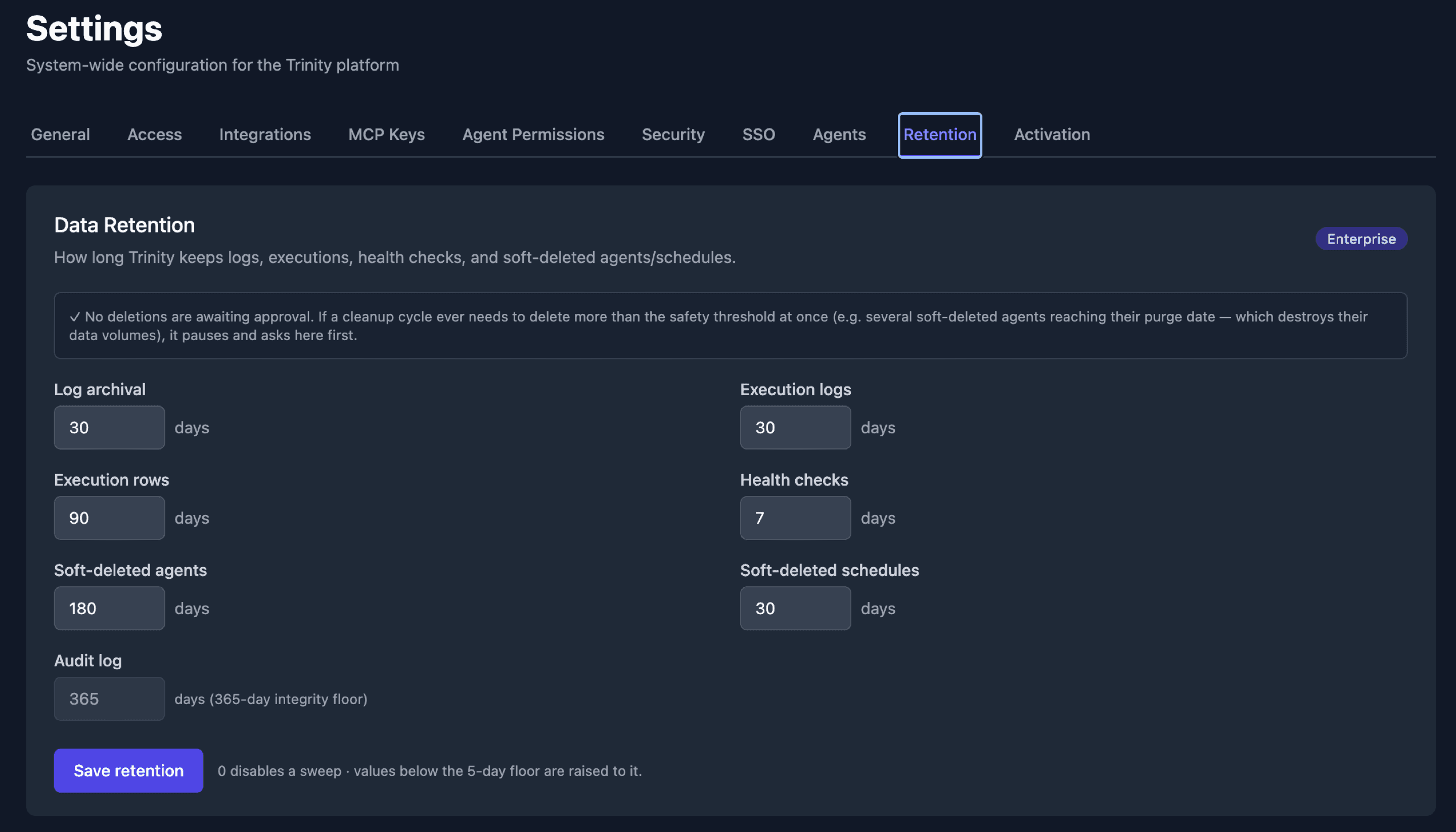
Trinity now takes automatic nightly database backups — verified recovery points for both SQLite and PostgreSQL, plus a pre-migration copy whenever an upgrade is pending. Container logs are bounded, closing the class of disk-full failures that could wedge Docker itself. Rebuilt agent base images are now actually adopted on cold start, fleet restart, and by the system agent. And a self-monitoring canary harness runs against production, elects one leader, names the instance that fired an alert, and retries lost Slack alerts.
More improvements
ask_trinity MCP tool answers platform questions from live documentation.Fixes
github: agents finally render .mcp.json.template, and plugin install-state survives container recreation via a committed, self-healing manifest..env stops reaching the next execution, quoted values round-trip uncorrupted, and global PAT rotation reaches every agent.TZ.Security & Hardening
require_admin/assert_adminnow refuse agent-scoped principals — the root cause behind four prior privilege escalations, closed at the chokepoint.Upgrade Notes
docker compose build before start.sh. GET /api/versionreports both the code in service and the image it runs in — if they differ, the image is stale.TEMPLATE_REGISTRY_ENABLED=false or use the Settings override.~/trinity-data/backups/, 14-day retention — budget disk accordingly. Same-disk scope: this protects against corruption and bad migrations, not disk loss. DB_BACKUP_ENABLED=false disables.skills_library_url becomes a multi-source table; an existing URL is adopted as a custom source, and moved tag pins are refused, never silently adopted.65182c1— earlier pins silently degrade entitled PostgreSQL instances to OSS-only.Known Limitations
call_a2a_agent is default-OFF behind an admin-managed endpoint registry.